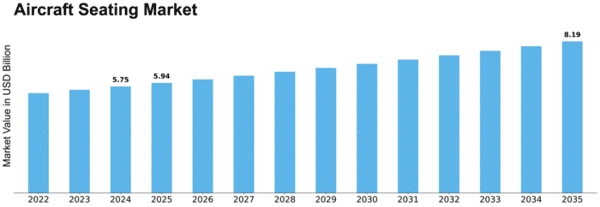
As per MRFR analysis, the Aircraft Seating Market was estimated at 5.75 USD Billion in 2024. The Aircraft Seating industry is projected to grow from 5.94 USD Billion in 2025 to 8.19 USD Billion by 2035, exhibiting a compound annual growth rate (CAGR) of 3.26 during the forecast period 2025 - 2035.
Introduction
Aircraft seating plays a critical role in defining passenger comfort, airline branding, safety compliance, and operational efficiency. Modern aircraft seats are no longer limited to basic functionality; they integrate lightweight materials, advanced ergonomics, smart features, and premium aesthetics. With global air traffic rebounding and fleet modernization accelerating, aircraft seating has become a key investment area for both commercial and defense aviation sectors.
Market Growth and Trends
The aircraft seating market is experiencing steady growth due to rising air passenger traffic, increasing aircraft deliveries, and growing demand for cabin upgrades. Airlines are focusing on improving passenger experience to gain a competitive edge, driving demand for premium economy and business-class seating solutions.
Lightweight seating solutions are a major trend, helping airlines reduce fuel consumption and operational costs. The use of composite materials, titanium, and advanced aluminum alloys has become widespread. Additionally, airlines are adopting modular seat designs that enable faster installation and easier maintenance.
Another notable trend is the integration of smart seating technologies such as seat actuation systems, in-seat power outlets, connectivity ports, and adjustable lumbar support. Sustainability is also shaping the market, with manufacturers investing in recyclable materials and eco-friendly production processes.
Key Players
The aircraft seating market is moderately consolidated, with established players focusing on innovation, customization, and strategic partnerships. Leading companies offer seating solutions across economy, premium economy, business, and first-class categories. These players continuously invest in R&D to comply with evolving safety regulations while enhancing passenger comfort and cabin aesthetics.
Future Scope
The future of the aircraft seating market looks promising with advancements in digital cabin solutions, personalized seating experiences, and lightweight smart materials. The growth of low-cost carriers is expected to drive demand for cost-effective and durable seating systems, while long-haul travel will boost demand for premium and lie-flat seats.
Emerging markets in Asia-Pacific and the Middle East will play a vital role due to expanding airline fleets and airport infrastructure development. Retrofit and replacement demand will also contribute significantly as airlines upgrade existing cabins to meet changing passenger expectations.
FAQs
Q1. What factors are driving the aircraft seating market?
Rising air travel demand, fleet expansion, cabin modernization, and passenger comfort expectations.
Q2. Which seating class dominates the market?
Economy class seating dominates due to high passenger volume, but premium economy is growing rapidly.
Q3. What materials are commonly used in aircraft seating?
Lightweight composites, aluminum alloys, titanium, and fire-resistant fabrics.
Q4. How does aircraft seating impact airline profitability?
Optimized seating layouts and lightweight designs reduce fuel costs and increase seating capacity.
Q5. What is the future growth outlook?
Steady growth driven by technological innovation, sustainability, and emerging aviation markets.
Discover More Research Reports on Aerospace & Defense By Market Research Future:
Military Aircraft Digital Glass Cockpit Systems Market
Aerostat Systems Market
In-Flight Catering Service Market
Military Aircraft Avionics Market
Airborne ISR Market